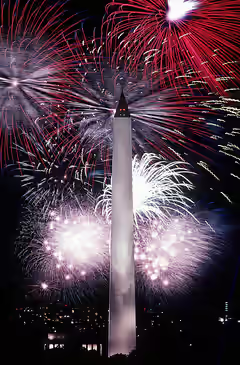
Across the United States, the night arrived in layers: the low percussion of marching bands, the paper-snap of flags in summer air, the smell of grills working overtime, and finally the bright punctuation of fireworks above familiar skylines. Independence Day has always been a national ritual. In 2026, it carried a larger number and a heavier question. The United States was turning 250.
01 / THE BIRTHDAY SCENE
A FOURTH OF JULY
WITH AN EXTRA ZERO.
On the National Mall, the monuments supplied the backdrop while visitors moved through security checkpoints and temporary street closures established for the national celebration. The familiar elements remained—music, flags, families claiming patches of grass, and fireworks after dark—but the semiquincentennial made the day feel less like another annual holiday and more like a generational marker.
The official America250 program framed July 3 and 4 as “America’s Block Party,” connecting major events with local celebrations. Its live platform highlighted host cities including New York, Los Angeles, Boston, Philadelphia and Fort Campbell, alongside state commissions and neighborhood gatherings. The idea was deliberately decentralized: America’s birthday would not belong only to a stage in Washington. It would be assembled from thousands of versions of the day.
That approach matched how the Fourth is actually experienced. The national symbols may be shared, but the soundtrack changes by ZIP code. In one town, independence looks like folding chairs beside a fire station. In another, it is a rooftop view, a baseball game, a citizenship ceremony, a church picnic or a community reading of the Declaration. The 250th anniversary made those small traditions part of the headline.
ONE COUNTRY.
— THE WIKIPLOTS NEWS DESK
MILLIONS OF WAYS
TO MARK THE MOMENT.
02 / COAST TO COAST
THE NATIONAL PARTY
WENT LOCAL.
Monuments, music, security perimeters and the capital’s signature fireworks.
Major programs connected cultural capitals and military communities across the map.
Neighborhoods made the milestone personal through food, service and local tradition.
The official celebration also promoted “Giving 4th,” an effort to add service and charitable giving to the usual calendar of parades and cookouts. It was a meaningful shift in tone. A birthday can be about receiving attention; a civic birthday can also ask what citizens are prepared to give one another.
Not every gathering looked the same or carried the same politics. That, too, was part of the picture. A nation this large does not arrive at a single mood on command. Some people approached the anniversary with uncomplicated pride. Others used it to honor military service, immigrant journeys or civil-rights struggles. Still others treated the date as an invitation to protest, mourn exclusions in the country’s history, or demand a more complete version of its founding promises.
The official calendar made the scale visible. The National Archives planned a public commemoration steps from the original Declaration. The Library of Congress offered a family day. Historic sites, museums, local governments, orchestras, fire departments and neighborhood groups filled the map with programs that ranged from citizenship ceremonies to concerts and battlefield interpretation. The result was less a single event than a temporary civic network.
That network matters because national memory is usually built locally. A federal commission can create a date and a framework, but communities decide which stories receive a microphone, which archives come out of storage and which questions are safe enough—or urgent enough—to discuss in public. The strongest local programs did more than add a “250” logo to an annual festival. They used the anniversary to connect a familiar place with the people who had made, contested and changed it.
03 / THE MEMORY WORK
A BIRTHDAY IS ALSO
AN EDITING DECISION.
Big anniversaries can make history look inevitable. A timeline moves from 1776 to 1876 to 1976 to 2026; the nation grows, survives and arrives at the present as if following a route printed in advance. Real history is less orderly. Every commemoration selects a beginning, elevates certain characters and compresses conflict into a story short enough to place on a stage.
The 1876 Centennial Exhibition in Philadelphia advertised industrial confidence and national reunion only eleven years after the Civil War. It displayed invention and expansion, but the language of reunion could obscure the collapse of Reconstruction and the intensifying assault on Black citizenship. Indigenous nations appeared inside a national story that often treated westward settlement as progress while dispossession continued. The fair was impressive, popular and incomplete—all at once.
The 1976 Bicentennial arrived after Vietnam, Watergate and a decade of movements that had challenged official versions of American life. Its tall ships and fireworks projected continuity, while thousands of local history projects widened the record. Communities collected oral histories, restored buildings, staged festivals and argued over which past the celebration should represent. The anniversary became both spectacle and infrastructure: some of what people know about their towns today survives because the Bicentennial gave local archives a deadline and public attention.
The semiquincentennial inherited that tension. An inclusive anniversary cannot simply add more faces to an unchanged founding tableau. It has to ask how independence was experienced by enslaved people, free Black communities, Native nations, women without political rights, loyalists, immigrants and residents of territories whose relationship to federal power remains unequal. Those accounts do not weaken the national story. They explain what its ideals demanded, whom its institutions excluded and how change actually occurred.
There is also a difference between commemoration and consensus. People can share a public calendar without agreeing on a single interpretation. A useful civic anniversary creates enough common ground to examine evidence together while leaving room for disagreement about responsibility, progress and repair. The goal is not to make the past comfortable. It is to make public memory accurate enough to be useful.
04 / HOW WE GOT HERE
FOUR DATES.
ONE EVOLVING STORY.
THE DECLARATION
Congress adopts the Declaration of Independence in Philadelphia on July 4.
THE CENTENNIAL
A world’s fair in Philadelphia showcases a country transformed by industry and expansion.
THE BICENTENNIAL
Tall ships, neighborhood parades and nationwide projects mark America’s 200th birthday.
THE BIG 250
A coast-to-coast commemoration asks the country to celebrate, serve and tell its many stories.
The history behind July 4 contains its own useful correction. The Continental Congress approved the resolution for independence on July 2, 1776. It adopted the Declaration two days later, after debate and revisions. Printer John Dunlap produced the first broadside copies during the night, and they began traveling outward on July 5. The famous parchment was engrossed later, and most delegates began signing it on August 2—not together in one cinematic scene on the Fourth.
July 4 endured because it was the date printed at the top of the Declaration and the date the argument was formally presented to the world. The document was more than a breakup letter to Britain. It explained why a people believed government required consent and why rights could not be treated as gifts from a ruler. Those principles became the holiday’s lasting vocabulary, even when the nation failed to apply them equally.
The physical document has a history, too. The parchment traveled with the government during war, was repeatedly rolled and displayed, and suffered fading before modern conservation stabilized its environment. The National Archives now treats the Declaration as both a governing text and a vulnerable object. That distinction is useful: political language can feel permanent, but every record depends on people choosing to preserve, describe and make it accessible.
The first printing also reminds us that independence became public through media. Dunlap’s broadsides carried the adopted words beyond Congress; later printings added the signers’ names and helped turn a political act into shared evidence. In 2026, the channels were livestreams, social feeds, searchable collections and phone cameras. The technology changed. The civic problem did not: how does a large public encounter the same claim, test it against experience and decide what to do with it?
05 / THE PROMISE AND THE GAP
CELEBRATION IS EASY.
THE IDEAL IS HARDER.
At 250, Independence Day is both a celebration of a political revolution and an argument with its unfinished consequences. The declaration that “all men are created equal” emerged from a society that permitted slavery, denied women political power and displaced Indigenous peoples. The contradiction is not a footnote added by modern critics. It has shaped the country’s history from the beginning.
Generations of Americans have used the founding language to challenge the country to widen its definition of freedom. Abolitionists quoted it. Suffragists rewrote its cadence. Civil-rights leaders treated its promises like a check the nation was obligated to honor. Immigrants learned its phrases while building lives that stretched the meaning of American identity. The document’s power has often come from people who insisted it apply more fully than its authors did.
FREE—AND WHAT DO
WE OWE EACH OTHER?
That tension did not cancel the fireworks. It gave them context. Patriotism at the semiquincentennial could mean affection without amnesia: enjoying the spectacle, honoring sacrifice, noticing progress and still refusing to confuse an ideal with a completed task. A mature national story has room for pride and pressure at the same time.
The most durable expansions of American freedom were not automatic gifts from the founding. They came through organizing, litigation, elections, strikes, journalism, migration, mutual aid and, at times, war. The constitutional amendments that ended slavery, defined national citizenship and protected voting rights followed the Civil War. Women secured constitutional voting rights after generations of activism, though barriers persisted. Later movements forced the federal government to confront segregation, discriminatory immigration rules, inaccessible public life and unequal treatment under law.
That record changes the meaning of “founding.” A democracy is founded more than once: when principles are announced, when institutions are built, and whenever people previously excluded gain enough power to make those principles more real. The United States at 250 was therefore not merely looking back at a completed origin. It was measuring the distance between inherited language and lived citizenship.
SOURCES / READ DEEPER
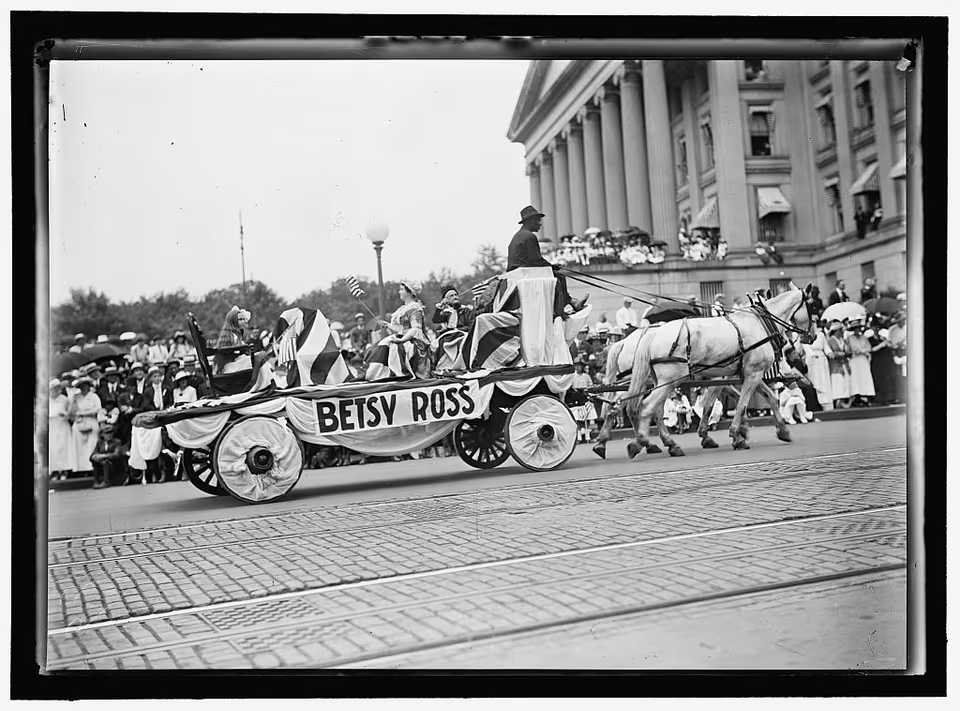
National Archives: The Declaration of Independence—A History ↗National Archives: Declaration of Independence—Milestone Document ↗National Archives: Creating the Declaration—A Timeline ↗Library of Congress: Fourth of July parade, Washington, 1916 ↗America250: America’s Block Party Live ↗America250: National commemorative events calendar ↗National Park Service: 2026 Independence Day Notice ↗250 YEARS—AND COUNTING.
History isn’t finished. It’s freshly printed.
PRINT ANOTHER STORY →